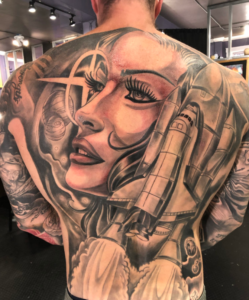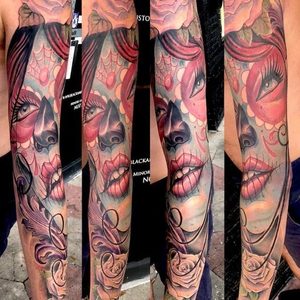
Few tattoo styles have the presence of a full Japanese sleeve or back piece. Bold waves, koi, dragons, flowers and masks flow across the body in one connected design. If you’re thinking about a Japanese tattoo, planning matters as much as the imagery. These pieces are often large, and they’re built over several sessions.
In a Hurry? Call 727) 498-1999
At Black Amethyst Tattoo Gallery in St. Petersburg, we design custom work around each client’s ideas and body. This guide covers the imagery in Japanese tattooing, how large pieces are planned and what to expect as your design comes together.

Alt text: Black and gray hannya mask tattoo with cherry blossoms, shown from two angles
Key Takeaways
- A Japanese tattoo usually combines a main subject with background elements like waves, wind bars or clouds.
- Common subjects include koi, dragons, tigers, hannya masks, and flowers like peonies and cherry blossoms.
- Large Japanese pieces, like sleeves and back pieces, are planned as one design that flows with the body.
- Big tattoos are completed over multiple sessions, so planning the full layout early helps.
- A free consultation is the best place to talk through imagery, size and placement with your artist.
What Defines a Japanese Tattoo?
Japanese tattooing has a long history, and its look is easy to spot. Designs use bold outlines, strong black shading and solid areas of color. Most pieces pair a main subject with a background that ties everything together. Waves, clouds, wind bars and flowing water fill the space around the subject and help the design move with the body.
Composition is a big part of what makes the style work. Rather than placing small, separate images, a Japanese tattoo is usually planned as one large piece. Each part leads the eye to the next, from the shoulder down to the wrist or across the whole back.
What Imagery Is Common in Japanese Tattoos?
Japanese tattoos draw from folklore, nature and art. Here are some subjects clients often ask about, along with the ideas commonly tied to them.
| Imagery | Commonly Associated With | Often Paired With |
| Koi fish | Perseverance and strength | Waves, water, lotus flowers |
| Dragon | Power and protection | Clouds, wind bars, flames |
| Tiger | Courage | Bamboo, wind, rocks |
| Hannya mask | A figure from Japanese theater | Flowers, smoke, clouds |
| Peony | Wealth and good fortune | Leaves, waves, other flowers |
| Cherry blossom | The short, fleeting nature of life | Branches, wind, water |
Meanings can vary by source and tradition, so your design doesn’t need to follow a strict rulebook. Many clients choose imagery because it speaks to them personally. Your artist can help you combine subjects so they work well together.
Why Are Japanese Tattoos Often So Large?
Large placements give the style room to do what it does best. A sleeve or back piece lets the background wrap around the body, which creates movement and a sense of flow. Smaller pieces can work too, but some of the detail and balance of the background may need to be simplified.
Common large placements include:
- Full sleeves, running from the shoulder to the wrist.
- Half sleeves, covering the upper arm or forearm.
- Back pieces, which can cover the entire back with one main scene.
- Leg sleeves, wrapping the thigh, calf or both.
- Chest panels, which often connect into a sleeve.
In a Hurry? Call 727) 498-1999
How Do You Plan a Large Japanese Tattoo?
A large Japanese tattoo is a long project, so it helps to think through the full design before the first session. Here’s how planning usually works at our shop:
1. Collect references. Gather images of subjects, backgrounds and Japanese work you like. Email them to the shop before your consultation, along with your name and phone number.
2. Schedule a free consultation. You can request a consultation online or call the shop to talk through your idea.
3. Map the full layout. Your artist will talk about how the main subject and background fit the area you’ve chosen, and what will and won’t work.
4. Book your first session. After your consultation, you set your appointment and leave a deposit to hold your time.
5. Build the piece over time. Large designs are completed across several sessions, often starting with the outline and main subject before moving to shading, color and background.
If you want to learn more about how our team turns ideas into original drawings, read our guide to custom tattoo design in St. Pete. You can also review what to expect at a tattoo consultation.
What Should You Expect Between Sessions?
Multi-session tattoos need healing time between appointments. Each session gives the skin time to recover before the next one, which helps keep the work clean and the color solid. Follow your aftercare closely, and check our tattoo healing information for guidance.
It also helps to plan your schedule ahead. If you need to change an appointment, our cancellation and rescheduling policy asks for at least 48 hours’ notice before the day of your session.
Why Choose Black Amethyst for Your Japanese Tattoo?
Black Amethyst Tattoo Gallery brings over 20 years of industry experience to custom tattooing. Our owner and lead artist, J. Michael Taylor, holds a Bachelor of Fine Arts degree from the Columbus College of Art and Design. That training in composition and color helps large pieces feel balanced from every angle. Browse our tattoo portfolio to see examples of bold, large-scale custom work.

Plan Your Japanese Tattoo in St. Petersburg
Ready to start planning your sleeve, back piece or other large design? Call Black Amethyst Tattoo Gallery at (727) 498-1999 or schedule your free consultation. We’ll talk through your imagery, placement and timeline so your Japanese tattoo comes together as one strong design.
Frequently Asked Questions
Q: What is a Japanese tattoo?
A: A Japanese tattoo is a traditional style known for bold outlines, strong shading and large, flowing designs. Most pieces combine a main subject, like a koi or dragon, with a background of waves, clouds or wind.
Q: How many sessions does a Japanese sleeve take?
A: It depends on the size, detail and how your skin heals. Large pieces are completed over several sessions, and your artist can give you a better idea during your consultation.
Q: Can a Japanese tattoo be small?
A: Yes, smaller pieces are possible, though some background detail may be simplified. The style tends to look its best when it has room to flow.
Q: Do I need to know the meaning of every element?
A: No. Many clients choose imagery because it feels personal to them. Your artist can help you combine subjects that look good together and fit your idea.