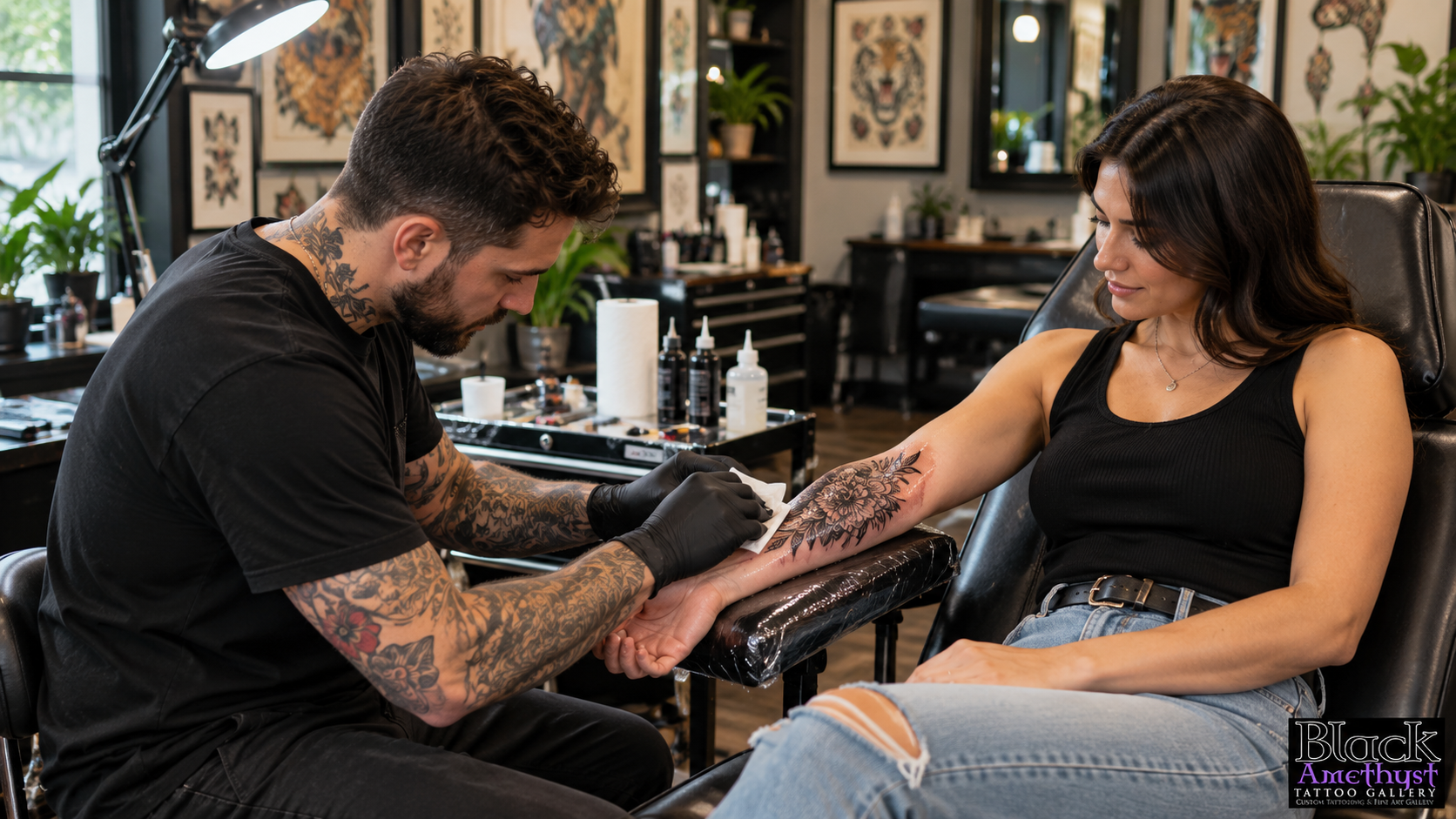
Colored tattoos can turn skin into a seriously bold canvas. From the rich reds and blues of a Japanese sleeve to bright cartoon characters, flowers, and traditional designs, color gives us a huge range of creative possibilities.
But color isn’t automatically the right choice for every tattoo.
The main advantages of colored tattoos are their visual impact, range of artistic options, and ability to bring certain subjects to life. The trade-offs can include more complex tattoo sessions, noticeable changes in color over time, extra attention to sun protection, and the possibility of reacting to a particular pigment.
At Black Amethyst Tattoo Gallery in St. Petersburg, we think the decision should start with the artwork you want—not with a rule that says color or black and grey is always better. Your design, placement, skin tone, preferred style, and expectations for how the tattoo will age all matter.
Key Takeaways
- Colored tattoos offer a broad palette and can bring depth, contrast, and personality to designs that depend on color.
- UV exposure can fade some tattoo inks over time, making long-term sun protection important for maintaining the tattoo’s appearance.
- Color work can take longer when a design requires multiple pigments, blending, saturation, or several passes.
- Any tattoo ink can cause a reaction, although dermatologists note that red is often associated with allergic ink reactions.
- Skin tone doesn’t automatically determine whether you can get a color tattoo. The palette, contrast, design, and artist’s approach need to work together.
- The best choice often comes down to what will serve the design well both now and years from now.
What Are the Pros and Cons of Colored Tattoos?
The biggest advantage of a colored tattoo is creative flexibility. Color can separate elements, establish contrast, create mood, and reproduce subjects that wouldn’t have the same character in black and grey.
The trade-off is complexity. More colors can mean more decisions about palette and saturation, and some pigments can change in appearance with long-term UV exposure. There are also health considerations associated with tattoo inks generally, including possible allergic reactions and infection.
Here’s what we think is worth considering before deciding.

Pro: Colored Tattoos Can Have Incredible Visual Impact
There is a reason people are drawn to color tattoos: they can be hard to ignore.
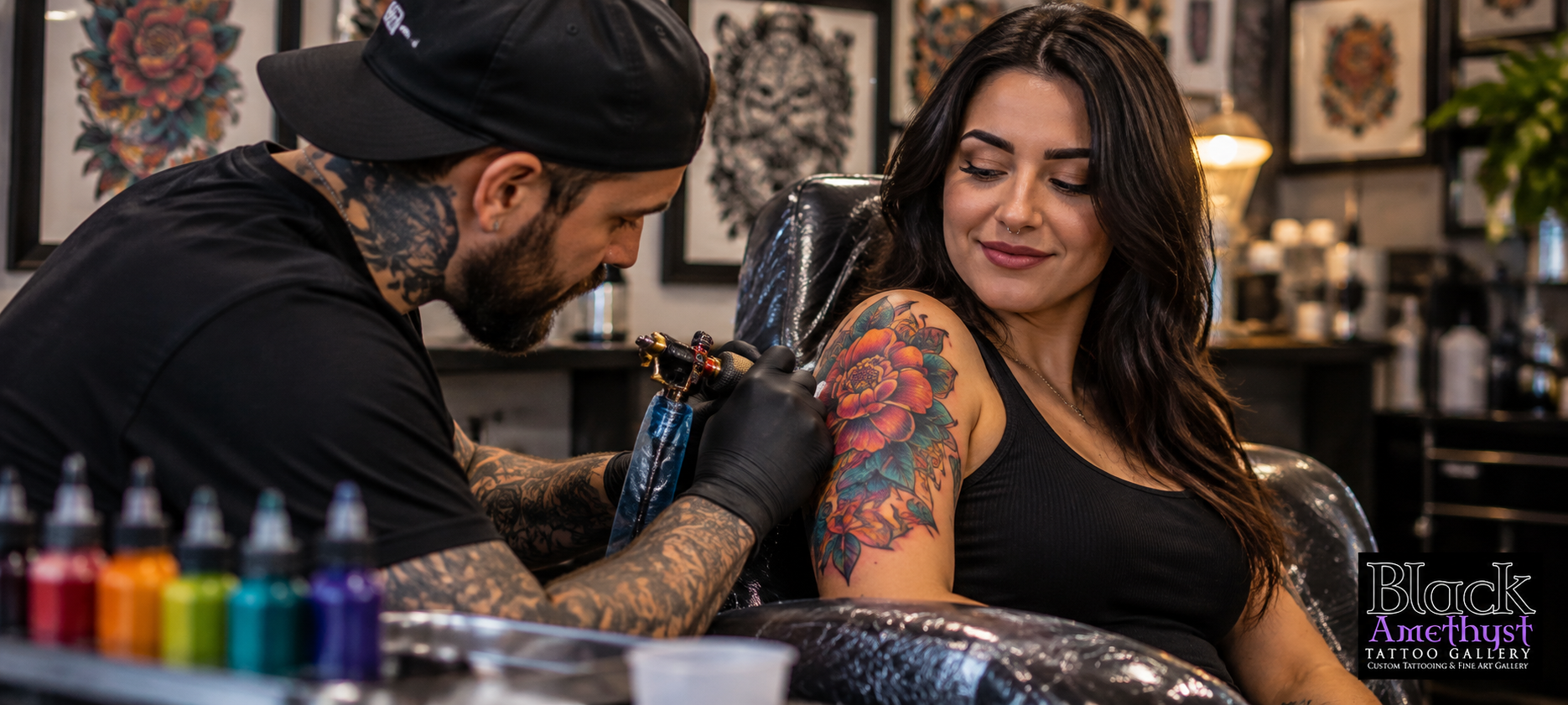
A saturated red rose, blue water surrounding a koi, or the exaggerated colors of a cartoon character can create a completely different effect from the same subject rendered only in black and grey.
Color can also help us establish visual separation within complicated pieces. Different elements can be distinguished through hue as well as outlines, shading, and negative space.
This can be particularly useful in larger designs where several subjects need to work together without turning into visual clutter.
Pro: You Have a Huge Range of Creative Options
Color opens up possibilities that simply aren’t available with black ink alone.
We can work with warm or cool palettes, complementary colors, subtle transitions, bold blocks of pigment, or carefully selected accent colors. The tattoo doesn’t necessarily have to be packed with every color in the spectrum, either.
Sometimes a limited palette is more effective.
A primarily black tattoo with carefully placed red, gold, green, or blue accents can give you some of the impact of a full-color piece while maintaining strong dark elements throughout the design.
That makes the real decision less about color versus no color and more about how much color serves the artwork.
Pro: Some Tattoo Styles Naturally Lend Themselves to Color
You can use color across many tattoo styles, but there are designs where it becomes a particularly important part of the visual language.
Japanese tattoos are a good example. Dragons, koi, flowers, waves, masks, and other elements give an artist plenty of opportunities to develop a deliberate color palette across a large composition.
Traditional tattoos can also use bold, recognizable colors alongside strong outlines.
Cartoon and illustrative tattoos are another natural fit. If color is part of what makes a character or image recognizable, removing it can completely change the feeling of the design.
At Black Amethyst Tattoo Gallery, we work with colorful tattoos as well as Japanese, traditional, cartoon, fine-line, sleeve, and custom tattoo designs. That means we can look at the artwork first and decide how color fits into it rather than forcing every idea into the same approach.
Pro: Color Can Help Create Contrast and Depth
A good color tattoo isn’t simply a drawing filled with different inks.
Contrast still matters.
Artists can use differences in value, saturation, hue, black shading, skin breaks, and outlines to make the composition readable. Those decisions become especially important in a sleeve or another large piece that may be viewed from several feet away.
This is one reason choosing a palette shouldn’t happen in isolation.
The question isn’t simply, “What are my favorite colors?”
It’s also: Which colors will help this particular design remain clear and visually balanced?
That is a much more useful conversation to have with your tattoo artist.
Con: Colored Tattoos Can Change in Appearance Over Time
No tattoo looks exactly the same forever.
Tattoo pigments can change over time, and light exposure is one factor. Research has documented photodegradation in tattoo pigments, although different pigments can behave differently.
The American Academy of Dermatology also notes that UV light can fade some tattoo inks and recommends protecting tattooed skin from the sun with broad-spectrum, water-resistant SPF 30 or higher once appropriate for healed skin.
This doesn’t mean your colorful tattoo suddenly disappears.
It means you should think about the tattoo as something that will live on your skin for decades.
Placement, sun exposure, pigment, design, and how you care for your skin can all influence what you see years later.
Will Colored Tattoos Fade Faster Than Black Tattoos?
You’ll often hear the blanket statement that color always fades faster than black. The reality is more nuanced.
Tattoo pigments have different chemical compositions and photostability, so they don’t all respond to light in exactly the same way. Research has shown that sunlight can contribute to the degradation of tattoo pigments, while some pigments are more photostable than others.
Rather than assuming every color will age identically, talk to your artist about the actual palette being considered and what you can realistically expect from the design.
Con: Detailed Color Work Can Require More Time
A tattoo with several colors may involve repeated color changes, blending, careful saturation, and transitions between different sections of the design.
That can add time compared with a simpler tattoo.
But “color tattoos always take longer” is too broad. A highly detailed black-and-grey realism piece can take much longer than a small, straightforward color tattoo.
Complexity matters more than the label.
When planning your appointment, consider the size, placement, detail, style, amount of shading, number of colors, and whether the tattoo will require multiple sessions.
Con: More Time and Complexity Can Affect the Price
Because tattoo pricing can be affected by the amount of work involved, an elaborate full-color piece may cost more than a simpler design.
Again, color alone doesn’t determine the price.
A small traditional color tattoo and a large black-and-grey sleeve aren’t comparable projects. Size, artist, complexity, placement, detail, session length, and whether the piece requires multiple appointments can all influence the final cost.
The most useful approach is to discuss the actual design with your artist rather than trying to estimate the price based solely on whether it contains color.
Con: Allergic Reactions to Tattoo Ink Are Possible
This is one area where it’s worth separating tattoo-shop advice from medical information.
The FDA has received reports of allergic reactions to tattoo inks and notes that reactions can sometimes persist because the ink remains in the skin.
The American Academy of Dermatology says an allergic reaction can occur immediately or much later. While any ink color can potentially cause a reaction, red is often the culprit in ink allergies.
Signs can include itching, swelling, redness, bumps, scaling, blisters, or other changes concentrated in a particular color.
If your tattoo isn’t healing as expected or you develop concerning symptoms, don’t assume that additional aftercare products will solve the problem. Contact an appropriate healthcare professional. Serious symptoms require prompt medical attention.
Are Colored Tattoos Harder to Heal?
Not necessarily.
It’s more accurate to say that the healing experience depends on the tattoo and how it was applied rather than assuming that color itself makes every tattoo harder to heal.
A large, heavily saturated color piece may involve substantially more work than a tiny black tattoo. But an intricate black-and-grey tattoo can also be extensive.
Size, placement, technique, the amount of work performed on the skin, your individual response, and proper aftercare all matter.
Regardless of color, tattooing breaks the skin barrier. The FDA warns that infections can result from unhygienic practices as well as contaminated tattoo ink, including ink from containers that appear sealed.
Follow the aftercare instructions provided for your tattoo, and pay attention to changes that don’t seem consistent with normal healing.
Do Colored Tattoos Work on Darker Skin?
Yes, color tattoos can be done on darker skin. The more useful question is which palette, contrast, and design approach will work for your skin and the tattoo you want.
Tattoo ink is viewed through the skin after healing, so the finished appearance of a pigment isn’t identical on every person. That doesn’t mean artists should simply divide people into “light skin gets color” and “dark skin gets black ink.”
Color selection should be intentional.
An experienced artist can discuss contrast, values, saturation, line work, and the colors appropriate for the individual design. Looking at an artist’s healed work on skin tones similar to yours can also give you a more useful reference than looking only at freshly tattooed photos.
Do Colored Tattoos Need More Aftercare?
During initial healing, the priority for any tattoo is following the aftercare instructions appropriate for the work you’ve received.
Long term, sun protection becomes particularly important if preserving the appearance of your tattoo is a priority.
The American Academy of Dermatology states that UV light can fade some tattoo inks. For healed tattoos exposed to sunlight, it recommends broad-spectrum, water-resistant SPF 30 or higher, along with other sun-protection measures.
Sun protection isn’t just a color-tattoo issue. It’s good practice for tattooed skin in general.
Colored Tattoos vs. Black and Grey: Which Should You Choose?
Neither option is automatically better.
Choose based on the artwork, the visual effect you want, and how the tattoo fits your long-term preferences.
Color may make sense when:
- Color is an important part of the subject or style.
- You want a bold or highly expressive design.
- The tattoo relies on several hues to separate elements.
- You’re drawn to colorful Japanese, traditional, cartoon, or illustrative work.
- You’re comfortable protecting the finished tattoo from excessive sun exposure.
Black and grey may make sense when:
- You prefer a more restrained or monochromatic appearance.
- The design depends heavily on line work, texture, contrast, or shading rather than hue.
- Black and grey better fits your existing tattoos.
- You simply prefer how the artwork looks without color.
There is also a third option: combine them.
A tattoo can use strong black line work and shading with selective areas of color. For some designs, that balance produces exactly the effect the client wants.
Think About the Entire Tattoo, Not Just the Ink Color
One of the easiest mistakes to make is choosing the palette before fully thinking through the tattoo.
Start with the bigger questions.
What are you getting tattooed on? How large will it be? Where will it go? Do you want people to notice it from across the room, or discover the details up close? Is it part of a future sleeve? Does it need to work around existing tattoos? Is there a specific tattoo style you’re trying to capture?
Those answers can change the color strategy.
For example, a palette that looks fantastic in a medium-sized traditional tattoo may not be the approach we’d use for an elaborate Japanese sleeve. A tiny piece also can’t always support the same color transitions and details as a larger canvas.
Design and color need to be planned together.
Should You Get a Colored Tattoo?
A colored tattoo is worth considering when color adds something meaningful to the design rather than being added simply because it’s available.
If your idea depends on bold contrast, recognizable colors, or a particular artistic style, color can be a major part of what makes the tattoo work. If the design is stronger through line work, texture, shadows, and negative space, black and grey may be a better fit for the look you’re after.
You don’t have to solve that question before speaking with an artist.
Bring the idea. Bring references if you have them. Then talk through the design, placement, size, palette, and how you want the finished tattoo to feel.
FAQs About Colored Tattoos
Q: Do colored tattoos fade?
A: All tattoos can change over time. UV exposure can fade some tattoo inks, and scientific research has documented light-related degradation of certain tattoo pigments. Protecting healed tattooed skin from excessive UV exposure can help preserve its appearance.
Q: What tattoo colors cause the most allergic reactions?
A: Any tattoo ink can potentially cause a reaction, but the American Academy of Dermatology says red is often the culprit when someone develops an allergic reaction to a specific ink color. Reactions can occur shortly after tattooing or much later.
Q: Are colored tattoos more expensive?
A: They can be, particularly when the design requires additional time for multiple colors, blending, saturation, or detailed transitions. However, tattoo price depends on the complete project rather than color alone. A complex black-and-grey piece may require more work than a simple color design.
Q: Can you get colored tattoos on darker skin?
A: Yes. Skin tone should be considered when planning the palette and contrast, but darker skin doesn’t automatically rule out color. Talk with your artist about how the proposed colors and design are expected to appear after healing.
Q: Can I combine color with black and grey?
A: Absolutely. A design doesn’t have to be exclusively full color or black and grey. Black line work, shading, and selective color can all be incorporated into the same piece when the approach fits the artwork.
Q: Are colored tattoos safe?
A: Tattooing carries risks regardless of whether the tattoo is colorful or black and grey. The FDA identifies potential complications including infection, allergic reactions, granulomas, keloids, and other adverse effects. It also notes that no color additives are FDA-approved for injection into the skin for cosmetic purposes.
Bring Your Color Tattoo Idea Now
The right tattoo isn’t determined by whether color or black ink wins a pros-and-cons list. It comes down to what works for your design, your skin, your style, and what you want to wear for years to come.
Here at Black Amethyst Tattoo Gallery, our artists create custom tattoos in St. Petersburg, including vibrant color work, Japanese tattoos, traditional tattoos, cartoon tattoos, sleeves, cover-ups, and fine-line designs.
Have an idea but aren’t sure whether it should be full color, black and grey, or somewhere in between? Visit us at 689 Dr. M.L.K. Jr St N #A in St. Petersburg or talk with our team about your design. We can help you work through the artistic options before it’s time to put ink to skin.